Cisco Packet Tracer · OSPF area 0
One link dies.
Nothing else does.
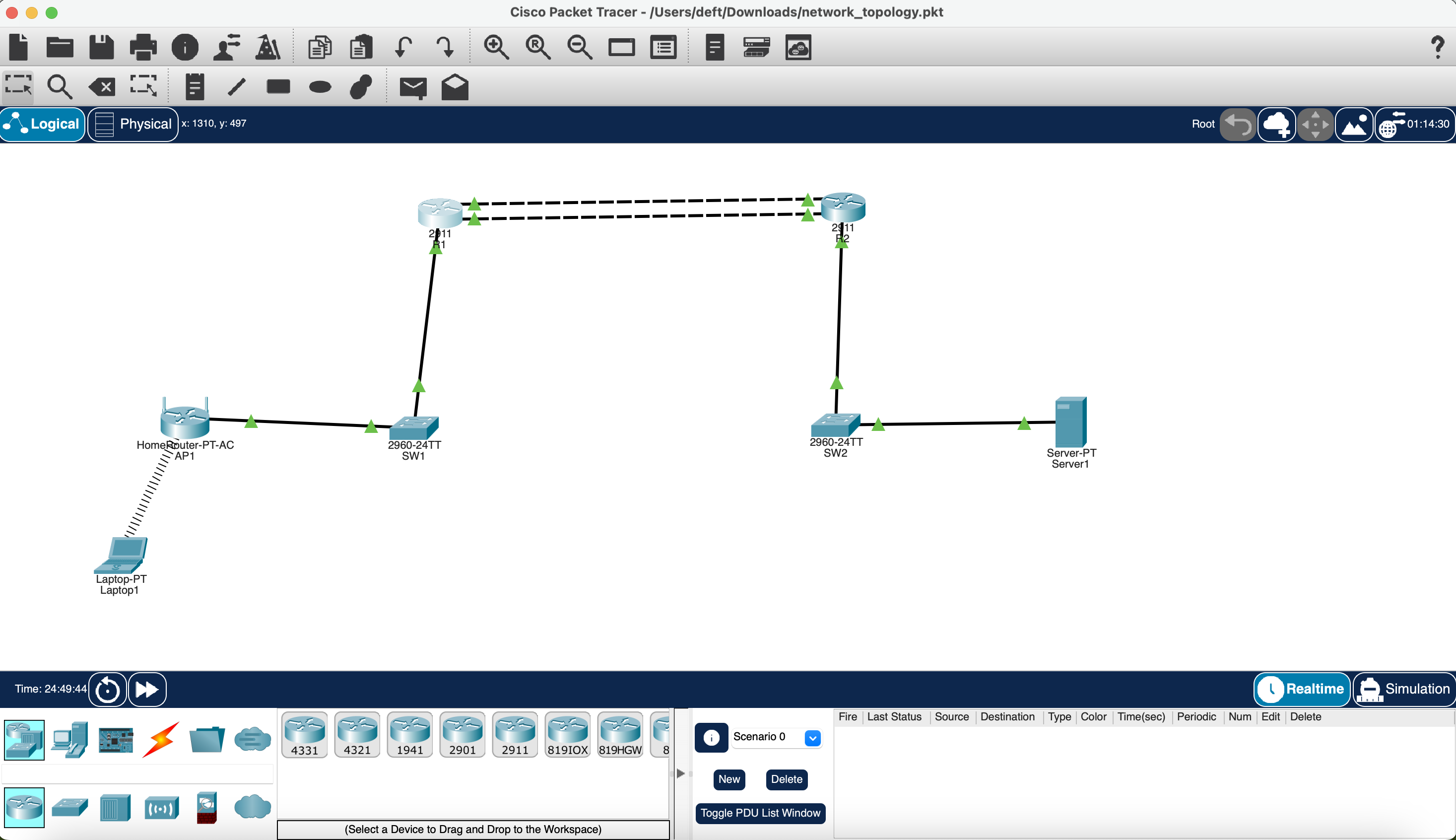
A server room network built on two redundant core links. When the primary path goes down, OSPF reconverges on its own and traffic keeps moving — no manual failover, no dropped packets.
packet loss measured across the simulated link failure
equal-cost OSPF paths carrying traffic between core routers
extended ACL filtering ICMP while leaving HTTP reachable
The build
Four moves, in order
Each step exists because the one before it created something to verify. The sequence matters — the failover test only means anything once the baseline is proven.
Address both core links
R1 and R2 are cabled twice over GigabitEthernet0/1 and 0/2, each on its own /30 — 10.0.0.0/30 and 10.0.0.4/30. Separate subnets keep the two paths independently routable rather than collapsing into one segment.
Run OSPF across both
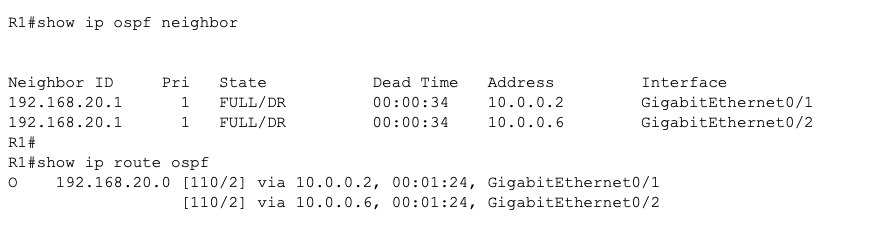
Every connected network is advertised into area 0 on both routers. OSPF forms a FULL adjacency over each link and installs two equal-cost routes to the server subnet, load-sharing rather than holding one in reserve.
Filter what reaches the server
An extended ACL on R2 denies ICMP from the client subnet to Server1 while permitting HTTP. Ping from the laptop fails by design; the web service stays reachable. Filtering is selective, not a blanket block on the remote site.
Break it and measure
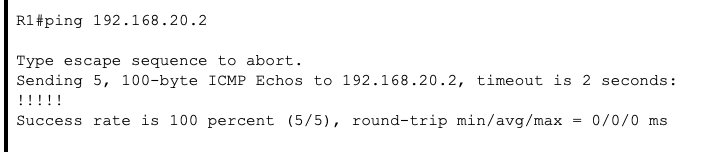
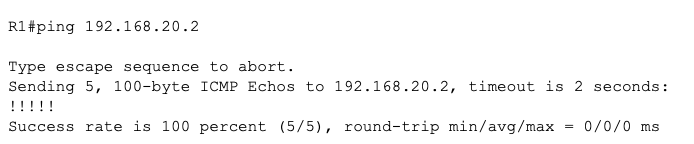
GigabitEthernet0/1 is administratively shut down mid-traffic. OSPF withdraws the dead path, the routing table drops to a single entry, and reachability holds at 100%. The recovery is the deliverable, not the configuration.
Evidence
Before and after the cut
Captured from the router CLI on both sides of the failure. Same command, same destination — only the surviving path changes.

Full topology
Wireless edge to data centre
Laptop1 joins over WPA2 through AP1, crosses SW1 and the redundant core, and lands on Server1 behind SW2.